Indian embassy celebrates Ayurveda Day, highlights Iran cooperation
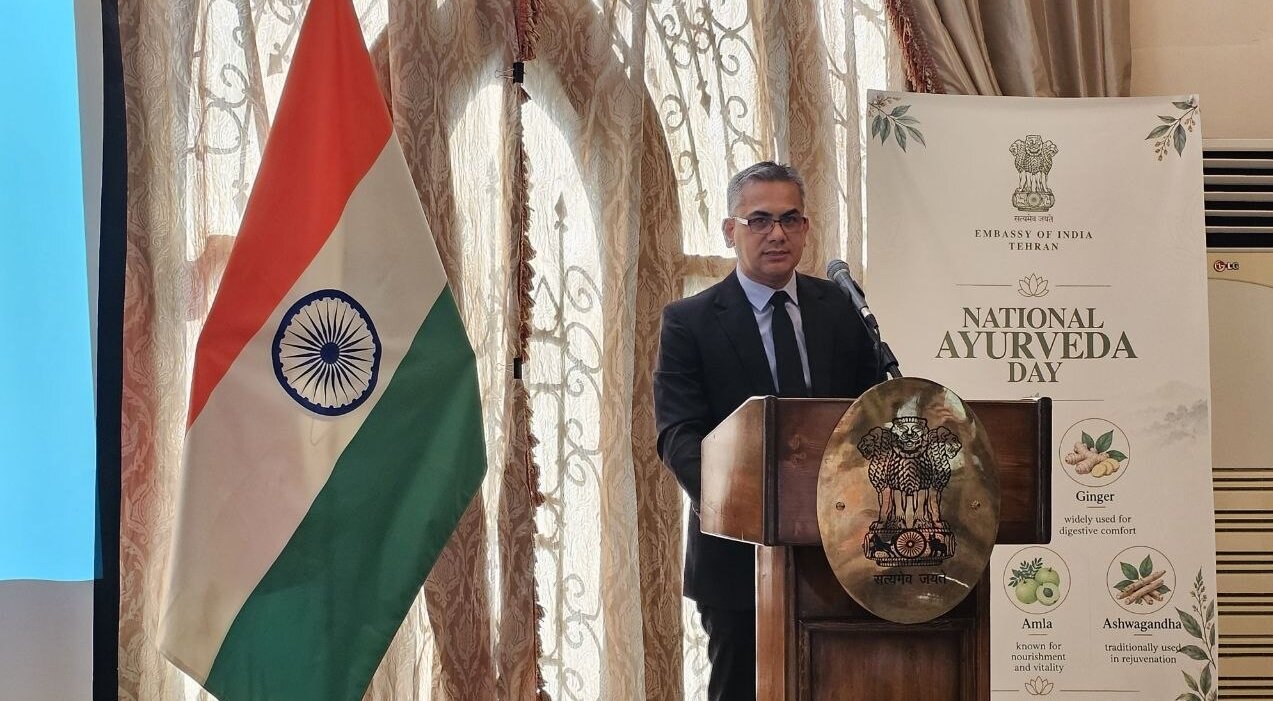
TEHRAN - The embassy of India in Tehran hosted a ceremony on Wednesday to mark National Ayurveda Day under the theme “Ayurveda for a Healthier Tomorrow,” bringing together diplomats, physicians, media representatives and enthusiasts of traditional medicine.
In his opening remarks, Indian Ambassador to Iran Vishwesh Negi said Ayurveda Day is observed to promote and revive the ancient Indian system of medicine, which is rooted in natural healing and a holistic approach to well-being.
Negi said the annual observance, initiated by the Indian government in 2016, seeks to raise international awareness of Ayurveda and its potential role in disease prevention and health promotion.
He also highlighted growing cooperation between Iran and India in traditional medicine, noting that the two countries have signed a memorandum of understanding between India’s Ministry of AYUSH and Iran’s Ministry of Health and Medical Education to build on their shared heritage of herbal and traditional remedies.
The ambassador referred to developments at the 16th BRICS Health Ministers’ Meeting in Chandigarh in July 2026, where traditional, complementary and integrative medicine was included in the agenda for greater cooperation among member states. The meeting’s declaration called for stronger collaboration in research, evidence generation, quality and safety.
Elsewhere in his remarks, the Inian envoy said the Ayurveda sector has experienced substantial economic expansion over the past decade, with the Ayurveda economy growing from $2.85 billion in 2014 to $43.4 billion in 2023, according to figures cited in his remarks.
He also highlighted the “Strategic Roadmap for Making Ayurveda Global,” released by NITI Aayog in July 2026. The roadmap sets out a phased strategy for expanding Ayurveda internationally, with emphasis on research, education, exports, regulatory alignment, international cooperation and quality standards.
Speaking at the ceremony, Paola Amadei, Italy’s ambassador to Iran, shared her experience of visiting India and spoke about the country’s rich culture and its traditional medical heritage, including Ayurveda.
Dr. Alireza Yargholi, a physician specializing in Persian medicine, addressed the historical and conceptual links between Persian medicine and Ayurveda. His presentation examined the two traditions from the perspective of shared concepts, historical exchanges, research and opportunities for future cooperation.
Dr. Arman Zargaran, an international affairs adviser at the Center for Iranian and Complementary Medicine of the Ministry of Health and Medical Education, discussed Iran-India cooperation in traditional medicine, including previously signed memorandums of understanding and ongoing joint activities.
Dr. Sohrab Dehqan, meanwhile, spoke about his studies of Ayurveda in India, the principles of the traditional medical system and his personal experiences.
Ayurveda derives its name from two Sanskrit words: “Ayur,” meaning life, and “Veda,” meaning knowledge. The system developed on the Indian subcontinent thousands of years ago, with roots in the Vedas, and traditionally seeks both to maintain the health of healthy people and to treat illness.
Speakers at the ceremony emphasized that Ayurveda is not presented as a rejection of modern medicine, but as an approach that places particular emphasis on prevention, daily routines, digestion, sleep and maintaining balance between body, mind and spirit.
AM
Leave a Comment